Here's a genre that's deader than the adventure game, so dead that nobody seemed to notice its passing: the flight sim. While you can still see the occasional arcade-style flight game, will anybody ever make a game with the balance of careful joystick manuevering and complex controls that Tie Fighter mastered in 1994? This game has never been surpassed, and won't be anytime soon.
Tie Fighter is a tough game, but I don't think I've ever played a flight game, or any action game for that matter, with such an emphasis on strategy over acrobatics. While good flying skills are useful, this is a game that inspires you to think hard about how to approach each mission. If you fail a mission a few times, there are many ways to get the upper hand; the targeting system, communication with wingmen, and the balance of power between engines, shields, and lasers all give you a way to improve your chances. The controls are daunting at first, but gradually become intuitive.
This is also a game that knows what to take from the Star Wars license. The starfighters are there, of course, and Vader and the Emperor play bit roles. But you're far removed from the events of the movie; from your perspective, the evil Empire is just a benevolent superpower out to promote law and order in the far reaches of the galaxy. Sound familiar? It's supposed to. Here's an excellent essay that will really want to make you play this game.
Sunday, July 3, 2011

Saturday, June 18, 2011
Halo: Fantasy for the Privileged
First person shooters are escapist fantasies, more than most genres. Doom and Duke Nukem 3D put you in the shoes of an 80s action movie hero. Half-Life is a revenge of the computer nerd fantasy.
Halo is a fantasy for the privileged child. The story of the Master Chief is not the story of the underdog, no matter how many Covenant ships are against you. You are pretty much invincible, and allies and enemies all seem to respect this. No character in this game really doubts your capability in any respect; everyone seems to have full confidence in you, and you don't disappoint them.
I had fun playing this game, or I least I wasn't bored enough to quit. But Halo has definitely lost whatever lustre it had. The characters are cut-out. There aren't enough enemy types to spread through ten levels. Worst is the level design itself - as if the areas weren't bland enough, they have the balls to force you to run through an identical-looking region three or four times in a row, in the same level. On more than one level. (We'll see what people think when the HD remake is released.)
I know this is a landmark shooter, but the repetition kills its fun value, at least in single player. The woefully underrated Timesplitters 2 was just a year later, and it solved this problem admirably.
Halo is a fantasy for the privileged child. The story of the Master Chief is not the story of the underdog, no matter how many Covenant ships are against you. You are pretty much invincible, and allies and enemies all seem to respect this. No character in this game really doubts your capability in any respect; everyone seems to have full confidence in you, and you don't disappoint them.
I had fun playing this game, or I least I wasn't bored enough to quit. But Halo has definitely lost whatever lustre it had. The characters are cut-out. There aren't enough enemy types to spread through ten levels. Worst is the level design itself - as if the areas weren't bland enough, they have the balls to force you to run through an identical-looking region three or four times in a row, in the same level. On more than one level. (We'll see what people think when the HD remake is released.)
I know this is a landmark shooter, but the repetition kills its fun value, at least in single player. The woefully underrated Timesplitters 2 was just a year later, and it solved this problem admirably.
Sunday, June 12, 2011
Executor, we must build additional pylons. Executor!?!
I suck at real-time strategy games. Building my headquarters, training a well-balanced and effective force, with only a guess as to the opponent's strength, strategy, and even location; it all makes me...exceedingly anxious. I get paranoid, and never make the bold move necessary to be a good commander.
When I was 10 or 11, I had a friend, the son of a youth pastor, who was addicted to Command and Conquer: Red Alert. I used to come over, watch him play, and admire his skills. The opening FMV, in which Einstein builds a time machine to go back and kill Hitler, unintentionally causing the rise of a greater Soviet threat, was fascinating to me. My friend's father eventually limited the time he could spend playing "war games," but by that time I owned the first C&C myself (a gift from another friend). I loved the FMVs (I was a child of the 90's), but I could never muster enough enthusiasm for the gameplay itself to finish it.
Last week, I finished my first RTS: the gold standard of the genre, Starcraft. It took me months, but I did it. And I have to say that it was, on the whole, not fun. I can appreciate how the different races, each forcing fundamentally different strategies, remain so delicately balanced. I even enjoyed the simple story of humans and honor-loving aliens joining forces to remove an infestation of large insects. I love that the outworld Terrans all sound like hicks. But it is very likely that, for me, the RTS will forever be a chore.
When I was 10 or 11, I had a friend, the son of a youth pastor, who was addicted to Command and Conquer: Red Alert. I used to come over, watch him play, and admire his skills. The opening FMV, in which Einstein builds a time machine to go back and kill Hitler, unintentionally causing the rise of a greater Soviet threat, was fascinating to me. My friend's father eventually limited the time he could spend playing "war games," but by that time I owned the first C&C myself (a gift from another friend). I loved the FMVs (I was a child of the 90's), but I could never muster enough enthusiasm for the gameplay itself to finish it.
Last week, I finished my first RTS: the gold standard of the genre, Starcraft. It took me months, but I did it. And I have to say that it was, on the whole, not fun. I can appreciate how the different races, each forcing fundamentally different strategies, remain so delicately balanced. I even enjoyed the simple story of humans and honor-loving aliens joining forces to remove an infestation of large insects. I love that the outworld Terrans all sound like hicks. But it is very likely that, for me, the RTS will forever be a chore.
Tuesday, March 23, 2010
Let the Gushing Begin
While spending 90 hours with Persona 3, and 75 hours with Persona 4, at a steady rate of two hours a night, four or so nights a week, I've had plenty of time to consider how I should praise these games. There has been much talk about how Persona 3 and 4 are unique among JRPGs, and why they should be seen as pinnacles for a flagging genre. I think it would be better to say that any gamer should break out their PS2 and give these a try, regardless of your feelings toward JRPGs. In many ways, Persona 4 has more in common with a Studio Ghibli movie than Final Fantasy. Clare and I have enjoyed these games tremendously (they are great games to play with a partner), and I plan on spending multiple posts elaborating on what makes them so good.
Both Persona 3 and 4 are excellent games. Unlike a lot of reviewers, I don't like to spend most of my time talking about all the minor improvements that each new iteration of a series makes. Suffice it to say that if you only have time to play one of these games, and they are long games, play Persona 4. They have entirely separate stories with different settings (and a single event that connects them, as a fan service), and according to one man's opinion, the improvements are worth something.For this reason, I'm going to spend most of my time talking about Persona 4, although there are interesting and important differences in setting and plot between the two games that I hope to talk about.
To save time, I'm also going to assume some familiarity with the basic mechanics and premise of the game. Reading through this spoiler-free description at HG101 is worth your time if you haven't played either of these games before; there are really no other games I'm aware of in the states that I can effectively compare these to.
With that out of the way, I'm going to list three aspects of Persona 4 that make it a special game for me. Then my plan is to spend one post elaborating further on each of these aspects, with maybe a conclusion post at the end. Here goes:
1. It's Japan, stupid!
Growing up as a fan of video games, I've learned that good localizations really do make all the difference. And though translations have gotten a lot better in the last five or ten years, way too many publishers try to pull the rug over our eyes about where a game originated, by replacing all references to Japanese culture with obvious American substitutions.
One of the few upsides of the diminishing market for Japanese games in the states is that those games that do make it over here are less afraid to show themselves for what they are to a more dedicated audience. Atlus is smart enough to figure out that Persona 3 and 4's rich grounding in Japanese culture was much more of an asset than a liability.
It doesn't do it justice to say simply that Persona 4 is set in Japan. Yes, you will learn many surprising facts about Japanese holidays, the rigid school system (6 days a week, with frequent testing), delicious-sounding food (P3 set Clare and I on a search for good ramen in Portland), and the complex meanings of the different Japanese signifiers (which are completely untranslatable).
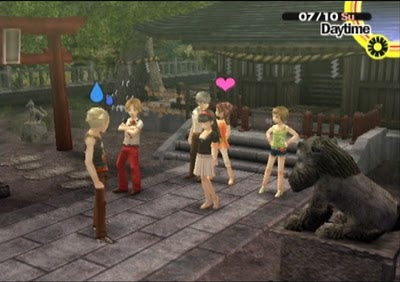
What makes P4 so unique and fascinating is that it is not a game about Japan, it is a game about Japanese people, who live in this culture and deal with these conventions. Your character experiences the pressure to get good grades in a school that posts the test scores of each student publicly. He risks embarrassment to show affection and perhaps have a relationship in front of disapproving adults. In its own implicit way, the game also confronts expected gender roles and homosexuality. All of these issues get reflected in the "other" world, in the bizarre nature of the enemies you fight (the game is similar to Earthbound in this respect). This leads into my second point:
2. Escaping the Representation-ist Philosophy
As we all know, RPGs started on the table top, as a way for adolescents to become heroes in a fantasy setting. The mechanics, dice-rolling and all, were simply a means to simulate the chance elements that factor into a real-life (or fantastical) battle.
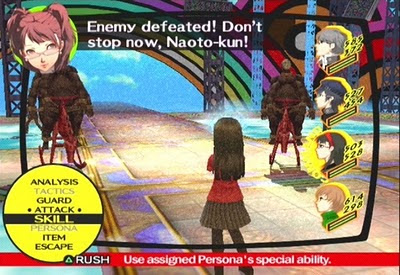 These days it's popular to call JRPGs derivative and uninnovative, but historically they have made one important development in the RPG form that Western developers have been slow to pick up on. They liberated the RPG mechanic from it's representation-ist origins. The kind of battles that take place in P4 make no sense realistically; you're looking at a bunch of kids carrying fans and baseball bats surrounding something called a "Fickle Papillons" (bunch of butterlies) and a "Chaos Fuzz" (crazy cop-gorilla hybrid). The battles that these simulate (in their own way) take place in the real world, with real-life enemies like depression and anxiety.
Plenty of JRPGs before P4 use interesting symbolism in the enemy design, but P4 is uniquely explicit in this regard (this is one way in which P4 excels P3 as well). The Personas that emerge from each character (as evil Shadows to be confronted) create their own worlds that reflect their own personal conflicts. The main insight that allowed the Persona series to be born from the giant Shin Megami Tensei juggernaut is that the demons that the characters control in those games are a lot like the inner kind that any high school student deals with.
3. A Sense of Time
One of my favorite aspects of Mother 3 is that for a very long time, the game is centered around different characters in a single community. Unlike so many RPGs, Mother 3 gave you a firm sense of home, something worth protecting (which also makes the surprise ending a lot more interesting).
P4 gives you more than a home, it gives you a normal life. No matter how serious the situation gets (and like many RPGs, the world is in peril), you will always be just a normal student to those around you. And God help you if you ever skip school.

Instead of progressing through places, P4 progresses through time, and the game is driven by a kind of rigid schedule. Some people complain about the level of grind in P3 and P4 (something that's offset by playing with a partner), but sticking in one place has some definite upsides. Characters can have roles more complex than a class type and a backstory; you're friends can have families, they can feel trapped in their jobs (many of which are inherited). Characters can be allowed to develop on their own instead of letting a constant change of venue drive them along.
Anyways, I hope to go into more detail soon. Till next time.
Screenshots from HG101, and 1up.
Both Persona 3 and 4 are excellent games. Unlike a lot of reviewers, I don't like to spend most of my time talking about all the minor improvements that each new iteration of a series makes. Suffice it to say that if you only have time to play one of these games, and they are long games, play Persona 4. They have entirely separate stories with different settings (and a single event that connects them, as a fan service), and according to one man's opinion, the improvements are worth something.For this reason, I'm going to spend most of my time talking about Persona 4, although there are interesting and important differences in setting and plot between the two games that I hope to talk about.
To save time, I'm also going to assume some familiarity with the basic mechanics and premise of the game. Reading through this spoiler-free description at HG101 is worth your time if you haven't played either of these games before; there are really no other games I'm aware of in the states that I can effectively compare these to.
With that out of the way, I'm going to list three aspects of Persona 4 that make it a special game for me. Then my plan is to spend one post elaborating further on each of these aspects, with maybe a conclusion post at the end. Here goes:
1. It's Japan, stupid!
Growing up as a fan of video games, I've learned that good localizations really do make all the difference. And though translations have gotten a lot better in the last five or ten years, way too many publishers try to pull the rug over our eyes about where a game originated, by replacing all references to Japanese culture with obvious American substitutions.
One of the few upsides of the diminishing market for Japanese games in the states is that those games that do make it over here are less afraid to show themselves for what they are to a more dedicated audience. Atlus is smart enough to figure out that Persona 3 and 4's rich grounding in Japanese culture was much more of an asset than a liability.
It doesn't do it justice to say simply that Persona 4 is set in Japan. Yes, you will learn many surprising facts about Japanese holidays, the rigid school system (6 days a week, with frequent testing), delicious-sounding food (P3 set Clare and I on a search for good ramen in Portland), and the complex meanings of the different Japanese signifiers (which are completely untranslatable).

What makes P4 so unique and fascinating is that it is not a game about Japan, it is a game about Japanese people, who live in this culture and deal with these conventions. Your character experiences the pressure to get good grades in a school that posts the test scores of each student publicly. He risks embarrassment to show affection and perhaps have a relationship in front of disapproving adults. In its own implicit way, the game also confronts expected gender roles and homosexuality. All of these issues get reflected in the "other" world, in the bizarre nature of the enemies you fight (the game is similar to Earthbound in this respect). This leads into my second point:
2. Escaping the Representation-ist Philosophy
As we all know, RPGs started on the table top, as a way for adolescents to become heroes in a fantasy setting. The mechanics, dice-rolling and all, were simply a means to simulate the chance elements that factor into a real-life (or fantastical) battle.
 These days it's popular to call JRPGs derivative and uninnovative, but historically they have made one important development in the RPG form that Western developers have been slow to pick up on. They liberated the RPG mechanic from it's representation-ist origins. The kind of battles that take place in P4 make no sense realistically; you're looking at a bunch of kids carrying fans and baseball bats surrounding something called a "Fickle Papillons" (bunch of butterlies) and a "Chaos Fuzz" (crazy cop-gorilla hybrid). The battles that these simulate (in their own way) take place in the real world, with real-life enemies like depression and anxiety.
Plenty of JRPGs before P4 use interesting symbolism in the enemy design, but P4 is uniquely explicit in this regard (this is one way in which P4 excels P3 as well). The Personas that emerge from each character (as evil Shadows to be confronted) create their own worlds that reflect their own personal conflicts. The main insight that allowed the Persona series to be born from the giant Shin Megami Tensei juggernaut is that the demons that the characters control in those games are a lot like the inner kind that any high school student deals with.
3. A Sense of Time
One of my favorite aspects of Mother 3 is that for a very long time, the game is centered around different characters in a single community. Unlike so many RPGs, Mother 3 gave you a firm sense of home, something worth protecting (which also makes the surprise ending a lot more interesting).
P4 gives you more than a home, it gives you a normal life. No matter how serious the situation gets (and like many RPGs, the world is in peril), you will always be just a normal student to those around you. And God help you if you ever skip school.
Instead of progressing through places, P4 progresses through time, and the game is driven by a kind of rigid schedule. Some people complain about the level of grind in P3 and P4 (something that's offset by playing with a partner), but sticking in one place has some definite upsides. Characters can have roles more complex than a class type and a backstory; you're friends can have families, they can feel trapped in their jobs (many of which are inherited). Characters can be allowed to develop on their own instead of letting a constant change of venue drive them along.
Anyways, I hope to go into more detail soon. Till next time.
Screenshots from HG101, and 1up.
Monday, March 22, 2010
What a Mathematican Does 101
My girlfriend is a biologist. I've noticed that introducing oneself as a biologist is a fairly good conversation starter. You don't have to be an expert in genetics or cellular biology to have an opinion about evolution or cloning. Even talking about your pet's strange behavior is fair game.
I am a mathematician. When I introduce myself as a mathematician, the response usually falls into one of three categories:
1. The "Oh, you must be pretty smart" response. I know people mean well, but I did not go into mathematics to impress people. Indicative of a larger problem, specifically the impression that you have to be a genius (usually some kind of detached savant) to work or take an interest in the subject. Also, hard to respond to. (I lean towards "Smart enough to work at Starbucks.")
2. The "I was bad at math in school" response. One of my professors told us once of a time when someone (I think a delivery man) nearly broke into tears when the professor introduced himself as a mathematician. The delivery man had such a traumatic and humiliating algebra class that just the mention of the subject sent him into shivers. It's true that most people are not as emotional about it. They mention their time in school because that is their only exposure to math, and the only way they can relate to me.
I can only sympathize and explain that math is a lot more stimulating when it's not a set of tools to be applied to boring problems. Though I did not struggle at math in high school, I didn't really enjoy it either, and I have a lot of sympathy with this perspective. I was a political science major until I realized how different math is in college (at least at Reed, where I was not forced to take two years of calculus before I could study something more fun).
3. Quietly and quickly moving to a different subject. This is by far the most common response.
Sad, but preferable to the first two.
A response I have never gotten, though I would love to get it, is "What does a mathematician actually do?" People do not usually ask this question, either because they are not interested or too embarrassed, although there is nothing to be embarrassed about. I didn't know the answer to this question until after I took two years of college math. Math professors don't usually tell you, because they're more concerned with helping you pass whatever class you're taking (and I'd never been brave enough to ask). However, it is a really important question, partly because there are so many misconceptions, many of which I fell victim to.
How would I answer this question? The short answer that I lean towards lately is "I study worlds that aren't real."
Most colleges group math with other sciences, and I understand the logic behind this. Besides the fact that science uses tools from math, both mathematicians and scientists observe things and make and test hypotheses. There are two differences.
Firstly, the things I observe are not facts about the world in which we live, but about worlds which are purely hypothetical. I study worlds like the world of natural numbers, the world of geometry, or the world of set theory. It is okay to call them models, but they don't necessarily "model" anything about the real world, or at least that is not the context in which I, as a mathematician, study them. Certainly, physicists or computer scientists might be interested in the conclusions I draw, but those are just applications and not the subject itself.
Secondly, unlike a scientist's conclusions, my conclusions can be completely verified, such that they can never be refuted. This is because certain axioms are true in these worlds, as well as certain rules of logic which let me derive things from them. Most people would say I assume the axioms, but I have a slight problem with the word "assume". I prefer to say that I am studying precisely that world in which these axioms are true. How do I know that there is such a world? Because I know that there are statements that can be derived from these axioms; in a certain sense, I am only dealing with language. (I choose to sidestep the Platonist-Antiplatonist debate about mathematical reality that pops up in math philosophy.)
Of course, what I have just stated sounds tremendously boring. It needs to be noted that a mathematician is not interested in all statements that can be derived from these axioms; one could tell a computer to derive statements for me, but the vast majority of these would be meaningless gibberish that no one could care less about. The statements that I am interested in are ones that are either useful for their applications, or just aesthetically pleasing (and the two go together far more often than not).
What does it mean for a fact about a hypothetical world to be aesthetically pleasing? Often, the worlds we're interested in can be visualized in interesting ways. Not just in terms of a picture, but in terms of examples from real life. But visualizations alone don't quite do it justice. Some facts we just want to be true; something we expect should be true by thinking of examples, but can't quite figure out why, until we do, which is gratifying. Some facts are very surprising, and they might help us conceptualize something we thought we had no hope of grasping. Some facts make connections between two worlds that seemed separate.
Part of being a mathematician is deciding what deserves to be studied; and like any scientist, we should be able to explain why the topic we've chosen is interesting, or just beautiful. There is an artistic aspect to math, just as there is a philosophical aspect.
Anyways, I hope to say more about certain aspects of the mathematician later. Comment if you have any questions.
I am a mathematician. When I introduce myself as a mathematician, the response usually falls into one of three categories:
1. The "Oh, you must be pretty smart" response. I know people mean well, but I did not go into mathematics to impress people. Indicative of a larger problem, specifically the impression that you have to be a genius (usually some kind of detached savant) to work or take an interest in the subject. Also, hard to respond to. (I lean towards "Smart enough to work at Starbucks.")
2. The "I was bad at math in school" response. One of my professors told us once of a time when someone (I think a delivery man) nearly broke into tears when the professor introduced himself as a mathematician. The delivery man had such a traumatic and humiliating algebra class that just the mention of the subject sent him into shivers. It's true that most people are not as emotional about it. They mention their time in school because that is their only exposure to math, and the only way they can relate to me.
I can only sympathize and explain that math is a lot more stimulating when it's not a set of tools to be applied to boring problems. Though I did not struggle at math in high school, I didn't really enjoy it either, and I have a lot of sympathy with this perspective. I was a political science major until I realized how different math is in college (at least at Reed, where I was not forced to take two years of calculus before I could study something more fun).
3. Quietly and quickly moving to a different subject. This is by far the most common response.
Sad, but preferable to the first two.
A response I have never gotten, though I would love to get it, is "What does a mathematician actually do?" People do not usually ask this question, either because they are not interested or too embarrassed, although there is nothing to be embarrassed about. I didn't know the answer to this question until after I took two years of college math. Math professors don't usually tell you, because they're more concerned with helping you pass whatever class you're taking (and I'd never been brave enough to ask). However, it is a really important question, partly because there are so many misconceptions, many of which I fell victim to.
How would I answer this question? The short answer that I lean towards lately is "I study worlds that aren't real."
Most colleges group math with other sciences, and I understand the logic behind this. Besides the fact that science uses tools from math, both mathematicians and scientists observe things and make and test hypotheses. There are two differences.
Firstly, the things I observe are not facts about the world in which we live, but about worlds which are purely hypothetical. I study worlds like the world of natural numbers, the world of geometry, or the world of set theory. It is okay to call them models, but they don't necessarily "model" anything about the real world, or at least that is not the context in which I, as a mathematician, study them. Certainly, physicists or computer scientists might be interested in the conclusions I draw, but those are just applications and not the subject itself.
Secondly, unlike a scientist's conclusions, my conclusions can be completely verified, such that they can never be refuted. This is because certain axioms are true in these worlds, as well as certain rules of logic which let me derive things from them. Most people would say I assume the axioms, but I have a slight problem with the word "assume". I prefer to say that I am studying precisely that world in which these axioms are true. How do I know that there is such a world? Because I know that there are statements that can be derived from these axioms; in a certain sense, I am only dealing with language. (I choose to sidestep the Platonist-Antiplatonist debate about mathematical reality that pops up in math philosophy.)
Of course, what I have just stated sounds tremendously boring. It needs to be noted that a mathematician is not interested in all statements that can be derived from these axioms; one could tell a computer to derive statements for me, but the vast majority of these would be meaningless gibberish that no one could care less about. The statements that I am interested in are ones that are either useful for their applications, or just aesthetically pleasing (and the two go together far more often than not).
What does it mean for a fact about a hypothetical world to be aesthetically pleasing? Often, the worlds we're interested in can be visualized in interesting ways. Not just in terms of a picture, but in terms of examples from real life. But visualizations alone don't quite do it justice. Some facts we just want to be true; something we expect should be true by thinking of examples, but can't quite figure out why, until we do, which is gratifying. Some facts are very surprising, and they might help us conceptualize something we thought we had no hope of grasping. Some facts make connections between two worlds that seemed separate.
Part of being a mathematician is deciding what deserves to be studied; and like any scientist, we should be able to explain why the topic we've chosen is interesting, or just beautiful. There is an artistic aspect to math, just as there is a philosophical aspect.
Anyways, I hope to say more about certain aspects of the mathematician later. Comment if you have any questions.
Tuesday, March 2, 2010
Morte and Murray
Can a man ever change his nature, even if he lived forever? Wouldn't he just make the same mistakes over and over again? If so, immortality would be a curse.
Two works come to mind that approach this question head-on, with very different conclusions. One is Planescape: Torment, the dark, brilliant 1999 computer RPG. The other is Groundhog Day, the 1993 philosophical comedy with Bill Murray.

In both works, the protagonist must repeat the same actions endlessly, but for different reasons. In Groundhog Day, Phil Connors (Murray) is cursed to wake up at 6:00 on February 2nd every day for infinity. In P:T, the Nameless One (he has forgotten his name long ago) has had his mortality removed. He can die, but he will eventually regenerate. If the death is harsh enough, he'll lose his memories, and the game starts after such an experience. You'll soon find out that there's virtually nothing you can do that you haven't already done thousands of times.

Thus both characters are immortal, although neither can truly progress until they change their nature. It's fun to watch Murray's character evolve over the course of the movie, from joy at the lack of consequences, to despair at his predicament, and eventually to selflessness and thus his redemption. Many see the movie as a religious parable, but I think it's rather the pressures of a mainstream release that necessitate a happy ending. It's a great movie (Murray is excellent), and definitely thought-provoking, but as a morality tale it provides a fairly simple prescription; to change your surroundings you must change yourself.
The Nameless One's goal is equally simple, yet nearly impossible: he wants to die (an ironic premise for an RPG, to say the least). The game stresses that there is no simple epiphany that will allow him to do this. Over the long course of his life, he has had many personalities, from saint to deranged psychotic. No matter how strong or smart he gets, he's been stronger and smarter, and it hasn't helped him one bit.
Here's my favorite experience in the game, and a pretty major spoiler (although nothing should stop you from playing this game). You learn that you were first cursed by a hag for failing to answer a riddle correctly, "What can change the nature of a man?" This point comes up repeatedly, and you have plenty of time to prepare the correct response to her question. When you finally meet her again, she does indeed ask it a second time, and you carefully pick the answer from an extensive list. But there is no right answer! The riddle is a ruse; you were cursed because you asked to be cursed, and the hag did so because she once loved you. There are no ultimate truths, and the only demon haunting you is yourself.
One crude but effective summarization of existentialism is that only you can give meaning to a life that has none intrinsically. It takes Connors years (presumably) to give meaning to a single day. The Nameless One's curse is that his life can never have meaning. That's why the question "What can change the nature of a man?" is a joke. The Nameless One has no hope of changing his nature, because he has no intrinsic nature (that's why he's nameless).
Connors eventually breaks free from his cycle, and the Nameless One (with a LOT of effort) dies and falls to the underworld. I find the endings of both works to be more ambiguous than they seem. What's really to stop Connors from falling into the same ego-centric habits on February 3rd?
In the Planescape universe, death is not a ticket to oblivion. The underworld is engaged in an eternal war between chaotic evil and ordered evil (perhaps one of the most dismal allegories for human existence). The Nameless One has broken his own cycle, only to find that the world itself has its own cycle which is far more dire. If Groundhog Day is hopelessly optimistic, than perhaps Planescape: Torment is hopelessly pessimistic.
No matter which conclusion you favor, Groundhog Day and Planescape: Torment each deserve more than the status of cult classic. P:T is especially underrated these days, and any RPG fan should definitely take a look.
Two works come to mind that approach this question head-on, with very different conclusions. One is Planescape: Torment, the dark, brilliant 1999 computer RPG. The other is Groundhog Day, the 1993 philosophical comedy with Bill Murray.

In both works, the protagonist must repeat the same actions endlessly, but for different reasons. In Groundhog Day, Phil Connors (Murray) is cursed to wake up at 6:00 on February 2nd every day for infinity. In P:T, the Nameless One (he has forgotten his name long ago) has had his mortality removed. He can die, but he will eventually regenerate. If the death is harsh enough, he'll lose his memories, and the game starts after such an experience. You'll soon find out that there's virtually nothing you can do that you haven't already done thousands of times.

Thus both characters are immortal, although neither can truly progress until they change their nature. It's fun to watch Murray's character evolve over the course of the movie, from joy at the lack of consequences, to despair at his predicament, and eventually to selflessness and thus his redemption. Many see the movie as a religious parable, but I think it's rather the pressures of a mainstream release that necessitate a happy ending. It's a great movie (Murray is excellent), and definitely thought-provoking, but as a morality tale it provides a fairly simple prescription; to change your surroundings you must change yourself.
The Nameless One's goal is equally simple, yet nearly impossible: he wants to die (an ironic premise for an RPG, to say the least). The game stresses that there is no simple epiphany that will allow him to do this. Over the long course of his life, he has had many personalities, from saint to deranged psychotic. No matter how strong or smart he gets, he's been stronger and smarter, and it hasn't helped him one bit.
Here's my favorite experience in the game, and a pretty major spoiler (although nothing should stop you from playing this game). You learn that you were first cursed by a hag for failing to answer a riddle correctly, "What can change the nature of a man?" This point comes up repeatedly, and you have plenty of time to prepare the correct response to her question. When you finally meet her again, she does indeed ask it a second time, and you carefully pick the answer from an extensive list. But there is no right answer! The riddle is a ruse; you were cursed because you asked to be cursed, and the hag did so because she once loved you. There are no ultimate truths, and the only demon haunting you is yourself.
One crude but effective summarization of existentialism is that only you can give meaning to a life that has none intrinsically. It takes Connors years (presumably) to give meaning to a single day. The Nameless One's curse is that his life can never have meaning. That's why the question "What can change the nature of a man?" is a joke. The Nameless One has no hope of changing his nature, because he has no intrinsic nature (that's why he's nameless).
Connors eventually breaks free from his cycle, and the Nameless One (with a LOT of effort) dies and falls to the underworld. I find the endings of both works to be more ambiguous than they seem. What's really to stop Connors from falling into the same ego-centric habits on February 3rd?
In the Planescape universe, death is not a ticket to oblivion. The underworld is engaged in an eternal war between chaotic evil and ordered evil (perhaps one of the most dismal allegories for human existence). The Nameless One has broken his own cycle, only to find that the world itself has its own cycle which is far more dire. If Groundhog Day is hopelessly optimistic, than perhaps Planescape: Torment is hopelessly pessimistic.
No matter which conclusion you favor, Groundhog Day and Planescape: Torment each deserve more than the status of cult classic. P:T is especially underrated these days, and any RPG fan should definitely take a look.
Saturday, February 13, 2010
Linearity vs. Spoilability: Part 2
This is a continuation of last week's linearity post.
2. Some games are much more spoilable than others
Last year, one of the recurring topics in the circle of game blogs I read is that of spoilers. Michael Abbott (who you should read, by the way) started it going with a post in which he complained that the community was being stifled by the fear of giving away plot details, even rather mundane ones, when discussing a game. Essentially, he said that this shouldn't be a big deal; indeed, most movie or book reviews assume that it's impossible to evaluate something without, well, talking about it.
A flurry of comments ensued. One of the more interesting ones was from Clint Hocking, lead designer of Far Cry 2 and a good game theorist to boot. He said that while it was possible to spoil a game's story, that's not really spoiling the game itself, which consists of a set of mechanics. Hocking questioned whether you could ever really spoil the mechanics of a game, which are generally assumed to be open knowledge.
As a designer, Hocking is interested in replaced fixed stories told through cutscenes with stories told through the player's point of view, so there's a motive behind his question. Setting all that aside though, it's not quite correct to say that game mechanics are never spoilable. I'm going to go through a few examples of this, many of which were brought up by commenters responding to Hocking.
Many games have mechanics that evolve in ways that surprise the player. The first, although probably not the best, thing that comes to mind is the grav gun in Half-Life 2. You probably won't find anyone who hadn't heard about the grav gun before playing the game, but nonetheless it is a mildly spoilable fact. Experimenting with it and finding new ways to use the grav gun is a fun experience, and if someone had listed all these ways out to me beforehand, I would've missed out on that.
One could argue that the basic mechanic of Half-Life 2 is that of a fairly conventional first-person shooter, the particular guns you use are simply variations on this mechanic, which is in itself not spoilable. But that's like saying that the story of Half-Life 2 is really just your basic tale of good vs. evil, or one man versus a vast government conspiracy, and thus it's not really spoilable either. Besides, some games really do change the fundamental mechanic. Imagine if someone had not told you that you will become a Jedi after the first couple levels of Jedi Knight 2. That would completely change your experience of that game. I think one of the reasons that Hocking doesn't consider mechanics spoilable is because it's conventional to spoil them anyway. (I'm not saying that's wrong; I take Abbott's position that there shouldn't be restrictions on the way we talk about games. But it is fair to say that knowing certain things about a game does change the way you experience it.)
Once I started thinking about this, it became clear that spoilability (by which I mean mechanic-spoilability, not story-spoilability) is already a criterion we use for games, though a bit subconsciously. Think about what defines a strategy game, for instance. One of the key characteristics of a strategy game in my mind is that it has little to no spoilability. Like chess, we know what the rules are; the game consists of applying them with skill. Similarly, certain puzzle games like Tetris are in no way spoilable. (It is important to specify the type of spoilability. For instance, one of the key rewards of playing Command and Conquer, at least for me, is watching the FMV cutscenes after each level, and I wouldn't want those spoiled. Obviously, that has nothing to do with the game mechanics.)
These types of games occupy one end of a spectrum. Slightly more spoilable are the types of games I mentioned earlier, in which the mechanics undergo small (HL2) to big (JK2) changes. How do we tell just how spoilable these games are? Pretty simple, really. Pick a game, and make up a story about what you did in this game. Not what your character did (your character is involved in the narrative), but how you as the player interacted with this game. Be as specific as you need to be to give someone a good impression of what you did; don't be abstract. Then think about whether this information would affect someone who knew nothing about the game yet.
You'll find that story-spoilability and mechanic-spoilability are usually correlated, but not always. The Xenosaga series (along with most modern RPGs) is highly story-spoilable but not very mechanic-spoilable.
What games are the most spoilable in terms of mechanics? Adventure games, almost by definition. In fact, I think the decline in adventure games has a lot less to do with linearity and a lot more to do with spoilability, and this is a connection I want to explore in Part 3.
2. Some games are much more spoilable than others
Last year, one of the recurring topics in the circle of game blogs I read is that of spoilers. Michael Abbott (who you should read, by the way) started it going with a post in which he complained that the community was being stifled by the fear of giving away plot details, even rather mundane ones, when discussing a game. Essentially, he said that this shouldn't be a big deal; indeed, most movie or book reviews assume that it's impossible to evaluate something without, well, talking about it.
A flurry of comments ensued. One of the more interesting ones was from Clint Hocking, lead designer of Far Cry 2 and a good game theorist to boot. He said that while it was possible to spoil a game's story, that's not really spoiling the game itself, which consists of a set of mechanics. Hocking questioned whether you could ever really spoil the mechanics of a game, which are generally assumed to be open knowledge.
As a designer, Hocking is interested in replaced fixed stories told through cutscenes with stories told through the player's point of view, so there's a motive behind his question. Setting all that aside though, it's not quite correct to say that game mechanics are never spoilable. I'm going to go through a few examples of this, many of which were brought up by commenters responding to Hocking.
Many games have mechanics that evolve in ways that surprise the player. The first, although probably not the best, thing that comes to mind is the grav gun in Half-Life 2. You probably won't find anyone who hadn't heard about the grav gun before playing the game, but nonetheless it is a mildly spoilable fact. Experimenting with it and finding new ways to use the grav gun is a fun experience, and if someone had listed all these ways out to me beforehand, I would've missed out on that.
One could argue that the basic mechanic of Half-Life 2 is that of a fairly conventional first-person shooter, the particular guns you use are simply variations on this mechanic, which is in itself not spoilable. But that's like saying that the story of Half-Life 2 is really just your basic tale of good vs. evil, or one man versus a vast government conspiracy, and thus it's not really spoilable either. Besides, some games really do change the fundamental mechanic. Imagine if someone had not told you that you will become a Jedi after the first couple levels of Jedi Knight 2. That would completely change your experience of that game. I think one of the reasons that Hocking doesn't consider mechanics spoilable is because it's conventional to spoil them anyway. (I'm not saying that's wrong; I take Abbott's position that there shouldn't be restrictions on the way we talk about games. But it is fair to say that knowing certain things about a game does change the way you experience it.)
Once I started thinking about this, it became clear that spoilability (by which I mean mechanic-spoilability, not story-spoilability) is already a criterion we use for games, though a bit subconsciously. Think about what defines a strategy game, for instance. One of the key characteristics of a strategy game in my mind is that it has little to no spoilability. Like chess, we know what the rules are; the game consists of applying them with skill. Similarly, certain puzzle games like Tetris are in no way spoilable. (It is important to specify the type of spoilability. For instance, one of the key rewards of playing Command and Conquer, at least for me, is watching the FMV cutscenes after each level, and I wouldn't want those spoiled. Obviously, that has nothing to do with the game mechanics.)
These types of games occupy one end of a spectrum. Slightly more spoilable are the types of games I mentioned earlier, in which the mechanics undergo small (HL2) to big (JK2) changes. How do we tell just how spoilable these games are? Pretty simple, really. Pick a game, and make up a story about what you did in this game. Not what your character did (your character is involved in the narrative), but how you as the player interacted with this game. Be as specific as you need to be to give someone a good impression of what you did; don't be abstract. Then think about whether this information would affect someone who knew nothing about the game yet.
You'll find that story-spoilability and mechanic-spoilability are usually correlated, but not always. The Xenosaga series (along with most modern RPGs) is highly story-spoilable but not very mechanic-spoilable.
What games are the most spoilable in terms of mechanics? Adventure games, almost by definition. In fact, I think the decline in adventure games has a lot less to do with linearity and a lot more to do with spoilability, and this is a connection I want to explore in Part 3.
Subscribe to:
Comments (Atom)