Richard II is yet another history about a bad king. Not wildly scheming and hilariously evil like Richard III, nor quietly ineffectual like Henry VI, just quite unpopular, due to holding high taxes on the commons, while at the same time disrespecting the rights of the aristocracy. He is deposed rather quietly, without much fuss, by the exiled duke of Hereford, who invades England while Richard is away in Ireland. No one seems much bothered except for one of the older lords, who knows that Richard's a lousy king, but who can appreciate that England is in for some trouble if no one's going to respect the divine right of succession.
The play sounds pretty boring on the surface, but save for the deliciously morbid Richard III, this is my favorite history yet. (Okay, the dry Henry VI series doesn't pose much of a threat, but still!) Richard is such a pathetic figure that it's extremely hard to take him seriously. But his monologues are so good! They're so tragic and poignant, but at the same time the man is so schizophrenic that an element of strong, dark humor is hard to ignore.
Again, no theatrical film adaptation that I could find; here good old BBC comes to the rescue as usual. Derek Jacobi overpowers the proceedings with an extremely self-indulgent performance. I think his interpretation, though definitely on the goofy side, is actually pretty defensible. Richard II has to be one of the most difficult parts in the Shakespearean repertoire. Even if Clare and I were nearly in stitches in a couple of these scenes, I think the humor has to be at least partly intentional on the author's part.
Tuesday, May 13, 2014

Monday, May 12, 2014
Deadly Premonition (Xbox 360, 2010) - Part 1
This game has gotten pretty famous, and most people have probably made up their minds one way or the other about it. Even so, I'm going to try to start at the beginning.
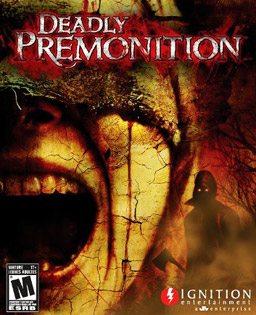
Here is the cover to Deadly Premonition, a game by the Japanese developer Access Games, who prior to this weren't known for much in the U.S., besides working on one of the Ace Combat games. Looking at this, you would probably guess that Deadly Premonition is a survival horror game. The game does indeed take many cues from the Silent Hill series: for example, the axe-wielding hooded man lurking in the corner is a kind of rip-off from "Pyramid Head". He drags that axe as he walks around, throwing sparks everywhere, and is impregnable to bullets until the end of the game.
To satisfy our expectations, the following shot represents the first hour or so of the game quite well.

Here is a shot from the next hour (for sticklers, this is actually the PS3 version, but it's close enough):

What you see here is the main character from the first shot, the FBI agent Francis York Morgan, exploring the sleepy town of Greenvale, Washington in a police cruiser. There are no monsters in this segment. In fact, less than half of my playthrough of this game was spent in the "dark world" (the percentage could be much less for those intent on completing all sidequests.)
So what the hell kind of game is this? If it's a survival horror game as the marketing would have us believe, then it's pretty mediocre and repetitive. Probably 90% of the enemies take the form of a clownish zombie who bends over backwards, like in that first screenshot. The combat is pretty simplistic stuff. At least it doesn't give you much trouble on medium difficulty.
If we're going to call it an adventure game with a GTA-like facade (the closest facsimile, in my experience, is the overworld component of No More Heroes), then it's still pretty lacking, since there's way too much driving and way too little to do in the town of Greenvale. The missions are almost invariably some form of point A to point B driving.
So any genre-based review of this game will be quite negative. It will also be wrong, because this game is an amazing experience and an absolute must-play. Why? Well, I'll have to go back to the beginning once again.
(Part 2 to come)
Here is the cover to Deadly Premonition, a game by the Japanese developer Access Games, who prior to this weren't known for much in the U.S., besides working on one of the Ace Combat games. Looking at this, you would probably guess that Deadly Premonition is a survival horror game. The game does indeed take many cues from the Silent Hill series: for example, the axe-wielding hooded man lurking in the corner is a kind of rip-off from "Pyramid Head". He drags that axe as he walks around, throwing sparks everywhere, and is impregnable to bullets until the end of the game.
To satisfy our expectations, the following shot represents the first hour or so of the game quite well.
Here is a shot from the next hour (for sticklers, this is actually the PS3 version, but it's close enough):
What you see here is the main character from the first shot, the FBI agent Francis York Morgan, exploring the sleepy town of Greenvale, Washington in a police cruiser. There are no monsters in this segment. In fact, less than half of my playthrough of this game was spent in the "dark world" (the percentage could be much less for those intent on completing all sidequests.)
So what the hell kind of game is this? If it's a survival horror game as the marketing would have us believe, then it's pretty mediocre and repetitive. Probably 90% of the enemies take the form of a clownish zombie who bends over backwards, like in that first screenshot. The combat is pretty simplistic stuff. At least it doesn't give you much trouble on medium difficulty.
If we're going to call it an adventure game with a GTA-like facade (the closest facsimile, in my experience, is the overworld component of No More Heroes), then it's still pretty lacking, since there's way too much driving and way too little to do in the town of Greenvale. The missions are almost invariably some form of point A to point B driving.
So any genre-based review of this game will be quite negative. It will also be wrong, because this game is an amazing experience and an absolute must-play. Why? Well, I'll have to go back to the beginning once again.
(Part 2 to come)
Sunday, May 11, 2014
Orange is the New Black - Season 1
After finishing this up yesterday, I was surprised to learn that the show is based on a real-life memoir of a white, female college graduate who spent a year in prison on a drug trafficking charge. This is surprising, because the majority of the characters in this show are, to put it lightly, far too crazy and/or bizarre to accurately reflect anyone living or dead.
There are important issues being covered here. I do think that the absurdities and abuses of our prison system are, in many ways, one of the defining issues of our times. But the caricatures on display here often go well beyond what I can take seriously, and I think this does a disservice to some very real problems. I can understand that making a comedy in a women's prison is walking a pretty fine line: this show's main problem is that it doesn't have much heart.
That's too bad, because the show is pretty smart about some things. For instance, the racial dynamics here are spot on. Piper, the main character, has friends and family that want to see her as better than her fellow inmates by virtue of being white. Despite this, Piper is often just as cruel and manipulative as everyone else, and there's a kind of deliciousness when the other characters pop her illusory bubble.
Saturday, May 10, 2014
Zelda Runthrough: The Wind Waker (Gamecube, 2003)
Besides giving me an excuse to replay some great games, the main reason I began this runthrough was to determine, once and for all, what is the greatest Zelda game. In that respect I've failed entirely. I now have more "favorite" Zelda games than ever: Link to the Past, Link's Awakening, Ocarina of Time, and Majora's Mask are all excellent for very different reasons, and being forced to choose between these feels... unnecessarily pedantic.
However, after more than a year, I'm finally ready to declare my first bold and unmitigated opinion: The Wind Waker is NOT the greatest Zelda game.
Okay, let me mitigate that a little: I enjoyed Wind Waker tremendously. Like nearly everyone, I'm a huge fan of the graphical style. It should be remembered that the decision to forgo the quest for "photorealism" and instead exhibit a crafted and conscious aesthetic style was extremely controversial in 2003. The decision paid off in spades. I love the way this game looks - to give just one example, I love Link's expressions. The scared look he gets in front of a boss, the solemn nod he gives when the King of Red Lions asks him whether he's ready, even the slightly queasy look he gets when he puts a Hyoi Pear on his head to attract a seagull. The game is overflowing with personality. I also love the story, the characters, and most of all the wonderful idea to set the game on the ocean. I even love the sailing, for all its flaws (on the Gamecube version).
So what's the problem? Well, if you've played the game, think about the first time you set out on the ocean on your tiny sailboat. An entire world out there for you to explore - who knows what you're going to find? And then you look at your map, and you see a nice 7x7 grid. It soon becomes apparent that every one of those squares on the grid, without exception, contains exactly one island. Suddenly that grand sense of mystery and adventure vanishes, and visiting all of the islands starts to feel like busywork. If you're old enough to remember how cool it was to find a hidden cave in Legend of Zelda, then imagine what would happen to your sense of wonder if EVERY screen in the game was guaranteed to contain one.
Now having 49 islands to explore is still pretty cool, even if finding them isn't exactly a challenge. But then you start to see how much repetition there is. Most of the islands only contain a few baddies to fight or a puzzle to solve for a reward, and there are just too many "eye reefs". Given the technical constraints, I don't fault Nintendo for not making every island unique and interesting. But consider that the rewards for exploring these islands are quite often treasure charts, which are there to generate yet more busywork.
I suppose it seems like I'm being grouchy, complaining that there's just too much to do in this game. But playing it a second time, it became clear that for all there is to do in Wind Waker, there's surprisingly little content. There are, after all, only four dungeons and one shortish boss tower. The game's "new" items, the grappling hook and Deku leaf, don't feel that unique. The combat is fun, but most of the enemies feel a bit overrecycled, and the challenge isn't really there (even in the misnamed Savage Labyrinth).
Wind Waker is a very good game, and I really want to just sit back and enjoy it without being nitpicky. Certainly the game has no shortage of fans, and if you feel that this one's the best, I certainly won't argue. But I can't help feeling that the game marks a real turning point for the series, and a certain sense of mystery that the early games had is being lost.
But Link has a way of always making me feel better.
Friday, May 9, 2014
Zelda Runthrough: Four Swords (GBA, 2002)
After taking a long break from Zelda games, I'm almost finished with Wind Waker, and I'll have plenty to say about that game soon. But first I have to take care of some unfinished business.
Four Swords is not a stand-alone game. Instead it's a multiplayer mode attached to the Game Boy Advance re-release of A Link to the Past. It requires two to four players to connect their GBAs (each with its own copy of the game) with link cables. For this reason, it's easy to see why the original release is not widely talked about. (A remake for the DSi was released online a few years ago, and then again earlier this year, to celebrate Zelda's 25th anniversary.)
It does have its own very simple story, told in two separate cutscenes at the beginning and end of the game, but it's terribly generic stuff about saving Zelda from a black bat-thing called Vaati. Link takes an artifact called the "Four Sword", which splits him to four differently-colored Links. The game has no overworld. Instead there are just three stages, each with a number of floors and a boss, and then a final stage where you fight Vaati himself.
The gameplay is pretty simple, but still quite a bit of fun. To obviate the need for an inventory screen, you can only hold one item at a time. Most of the puzzles require you to work together in some fashion - for example, the Links can toss each other over gaps when there's only one jump feather available. In an interesting twist, the levels are randomly generated, although this just means that pre-designed puzzles will appear scattered around in arbitrary order. After each level, a Great Fairy will appear, and judge you based on - get this - how many rupees you collected. (My wife and I consistently got the rating of "little eggs".) Rupees are quite important in this game, not only to please the capitalist deities, but because you spend them to regenerate your Links when they die.
Clare and I definitely enjoyed playing Four Swords, but I certainly wouldn't call this a hidden classic, because it's extremely short and not very difficult. Clare and I finished it in about three hours, beating Vaati quite easily our first time. I read online that one needs to play the game three times and get a ton of rupees in order to get the best ending, but I don't think there's enough content to warrant that kind of effort. If you have three GBA-owning friends, then this game might provide you with a fun and memorable afternoon, but otherwise, it's certainly no reason to go out and buy a second GBA (ahem).
If there's one thing to take away from Four Swords, it's that Capcom was more innovative with their approach to the Zelda series than the Oracle games would lead us to believe. Four Swords is a really good idea, one that they would make better use of later on.
Plus I love the way all of the Links have long bangs. Seriously, they're like a 90's boy band.
Monday, March 3, 2014
Final Fantasy IV (SNES, 1991)
Look at any contemporary adventure game review. Somewhere, you will see the author listing the annoying features of adventure games in their "golden age", the 90s, and deciding whether the subject of the review manages to avoid these or not. This has become a very tired and unnecessary cliché - not only has the definition of adventure game expanded broadly to include very cinematic un-puzzly games like The Walking Dead and Heavy Rain, but even "pure" modern adventure game developers, like Dave Gilbert and his development company Wadjet Eye games, have been good at designing very clean, well-clued puzzles, and avoiding crowded inventories and the like for over a decade. Should we be comparing the next Call of Duty iteration to Quake?
Similarly, it is a cliché in Japanese RPG reviews to claim that the genre has not freed itself from its own heyday in the 16- and 32-bit eras. I've always found this rather befuddling - it's clear to anyone who compares Final Fantasy VII with Final Fantasy XII or XIII that the genre has changed quite a bit. And that's not to mention the crazy things happening elsewhere in the genre, such as the Persona series, or even a critical darling like Dark Souls. But this critical consensus remains, and gets trotted out whenever we see something like Xenoblade Chronicles and Bravely Default, games which manage to scratch a nostalgic itch while still breaking new ground in their own ways.
In this popular narrative, the pinnacle (and hints of the eventual downfall) of the JRPG can be found in the two giants sitting astride a console generation gap - Final Fantasy VI and VII. And the clear template for those games would be the ever-underrated Final Fantasy IV. Together these games form a "classic trilogy" in the series.
It was my goal to ignore this whole narrative and nostalgia on this most recent playthrough of FF IV. What's left?
A nice, fun, relatively short RPG, that's what. It's a groundbreaking game, but there's surprisingly little that's actually new in Final Fantasy IV. The class system stays pretty close to FF III, but instead of four characters with changable class, there are twelve characters with (mostly) fixed class, and thus well-defined personalities. This leads naturally to a stronger story, much stronger than that of FF II, with lots more dialogue. The gameplay is simple but engaging; the newly patented Active Time Battle system keeps things artifically exciting to offset the loss of complexity. As for the technical side of things? Of course, there were huge advantages to working with the SNES as opposed to its predecessor, but it's proably fair to say that FF IV is a very wordy 8-bit game with lots of Mode 7.
Of course the story is the main draw. It's easy to forget that Squaresoft was taking a risk in putting such a big emphasis on plot. After all, FF II was not a huge success, and the Japanese public were happy to spend their paychecks on the dirt-simple Dragon Quest games. But Square was smart enough to see an opportunity to stand apart from the competition, and perhaps, although I have no evidence of this, they even foresaw success in America through this avenue. In any case, they found that success, despite an extremely sloppy translation and loads of NOA censorship*. It's rare to find a game that elicits such nostalgia in spite of itself. There are plenty of gamers who claim that every Final Fantasy after VII is garbage, but most of those gamers still have fond memories about this game, despite its many flaws.
So it's fair to say that, after lots of tweaking, Square hit the sweet spot, one that would prepare them for their later classics. But is it comparable to Final Fantasy VI or VII? Not really. While I think there's a (tentative) case to be made that an early game like Link to the Past is better than an acknowledged great like Ocarina of Time, I don't think this is one of those situations. Sure, FF VI can get a little convoluted if you're not paying attention, but the story of FF IV is still too simple to be very effective. The writers try to make up for this by having nearly every character sacrifice themselves at some point, only to come back later on. (This also lets the developers change the party members around. Never has a game so demanded the ability to change the party manually, and this would become possible in later editions.) At one point, three of your characters are simultaneously in bed, each recovering from a different "sacrifice". Clare and I joked that the dominant theme of the game might be "Convalescence".
But despite the fact that there are (at least) two much better Final Fantasies, I still agreed with my wife when she said that if she was looking for a fun, simple 30-hour JRPG that epitomized the genre, this is what she would recommend. This game really did set the template.
*Despite all advice to the contrary, I stuck to my stupid rules and played the game in its original U.S. incarnation. And to be honest, it wasn't that bad. Yes, the translation was really sloppy - lots of awkward word choices, occasional misattributed dialogue, and one very spoony bard. But enjoying this story even with the best of translations requires a healthy sense of humor. Yes, the North American version is easier, with many of the characters' abilities removed. But minimalism is a principal virtue of this game anyway, and none of the Final Fantasy games are really all that hard. What genuinely did bug me was the internal censorship. I still can't believe that Nintendo was so afraid of conservative backlash that they wouldn't even use the word "pray". And calling it the Tower of "Bab-il" wasn't fooling anyone. We still call this the "Golden Age" of RPGs, but it's clear to me that Nintendo wasn't the least bit interested in selling their games as art. Makes you really glad how far games have come (and how far they still have to go).
Saturday, December 14, 2013
Final Fantasy III (DS, 2006)
The third Final Fantasy game, the last for the Famicom, came out in 1990. It never left Japan. The first US incarnation, a full 3D remake for the Nintendo DS, did not appear for another sixteen years. According to the idiosyncratic rules I set for myself when I started this crazy completionist thing, this is the version I was to play.
So, needless to say, I have only a small notion of what this game would have been like upon its original release. But here's how I see it:
The first Final Fantasy had very little flexibility in its character classes. If players failed to create a decently balanced party, they could screw themselves over in the later stages of the game. Final Fantasy II tried to fix this by abandoning classes altogether, and instead having each skill and attribute level up with use. As I explained in my post on that game, the concept itself was innovative, but there were significant problems with the execution, since some skills (magic in particular) were bizarrely difficult to level up. With Final Fantasy III, character classes were brought back, but this time, characters could switch classes at will, and the number of classes jumped to 23. And thus the job system was born, an innovation that is Final Fantasy III's true legacy.
This system, substantially tweaked for the remake, works pretty well. The game even gets a little puzzly, forcing you to change classes to adapt to special dungeons. For example, a couple dungeons have tiny inch-wide openings, that only allow entry after the party casts the Mini spell on itself. Since Mini reduces physical attack and defense to 1, the only way to survive is to change everyone to a magic class and move them to the back row. There aren't too many examples like this, but enough to keep things fresh. Annoyingly, the game wants to discourage experimentation as well, significantly penalizing a character's stats after changing classes for up to 10 turns. It seems to me that if the developers wanted to prevent abuse of the system, it should just limit class changes to safe areas.
So how does the story compare? Well, in the Famicom version, you play as four (probably male) ciphers, as in FF1. In the remake, however, the characters have default names, and even simple backstories. The most fun thing about FF3 for me was inverting the standard RPG archetypes. By the end of the game, the "main" character, a white-haired vagabond named Luneth, was dressed up in white, doling out healing spells. Meanwhile the "token female" Refia had become a badass ninja, slicing up the final boss with shurikens.
(Although the characters have been substantially cute-ified. I guess it's understood that the characters are teenagers, but seriously, the character models look like kids playing dress-up. Even the main villain looks a wee bit adorable. I'm not saying that's necessarily a problem. Just don't plan on taking the game very seriously.)
The plot itself is, in this reviewer's humble opinion, fairly decent. It is very much the standard quest across the world (FF2 was an outlier in this regard), but there are some pretty cool settings, and I do love the idea that corresponding to the "Warriors of Light" (a returning device from FF1), there are "Warriors of Darkness" that save the world when people bring too much light into the world. Shades of FF6 there. All of the classic summon monsters (Shiva, Ramuh, Bahamut, et. al) make their first appearance. There are THREE distinct airships, one of which with the ability to go underwater. The Chocobo Theme is 500% less annoying - seriously, listen to the FF2 version, and you'll know what I mean. Finally, moogles.
So...after playing all three 8-bit Final Fantasies (only one of which on its original system), would I recommend any of them to a general gaming audience? RPGs today have better plots and more detailed mechanics. What's the point of playing something that does neither of those things particularly well?
To answer this question, I'll start by saying that, before this crazy retrospective, I was in a bit of an RPG rut. Skyrim, as great as it is, failed to inspire in me the same pleasure that I had received from games like Morrowind, Legend of Dragoon, and yes, Final Fantasies VIII and IX (for some reason, I wasn't that into VII). These three very simple JRPGs managed to rekindle my love of RPGs, for no other reason than that they forced me to rely on my sense of adventure and strong imagination.
So for anyone out there like me who still gets a little excited about sending four under-aged warriors on a quest to save the world, yes, dust off that NES, and give Final Fantasy a try. I really do think it's worth it.
Subscribe to:
Posts (Atom)